
Red, White, and Algal Blue
Welcome back to Data for Climate Progress — your one-stop shop for all things climate at Data for Progress.



🌈 HAPPY PRIDE 🌈
Welcome back to Data for Climate Progress — your one-stop shop for all things climate at Data for Progress. Catch us here every month for our latest climate polling, juicy insights, and can’t-miss reading lists.
As always, we’d love to hear from you — drop us (Grace Adcox and Catherine Fraser) a line at gracea@dataforprogress.org and catherine@dataforprogress.org. Forwarded this email? You can subscribe below.
Love this newsletter? Want to support our work? Donate here:

ISO a Chief Operating Officer …
We’re seeking a Chief Operating Officer (COO) to lead the internal operations and people systems that support our work across our 501(c)(3) and 501(c)(4). The COO will work closely with leadership across the organization on internal operations, capacity planning, labor relations, and financial management to ensure DFP has the structure, support, and internal coordination needed to meet the needs of the progressive community. Learn more and apply here.
… and a Development and Partnerships Director, Too
Our Development and Partnerships Director will lead Data for Progress’ fundraising and partnerships work across our 501(c)(3) and 501(c)(4). Reporting to the executive director, the development and partnerships director will play a central role in strengthening and growing the organization’s funding through foundation fundraising, major and small donor cultivation, institutional partnerships, and selected fee-for-service opportunities aligned with the organization’s mission and capacity. Learn more and apply here.

Introducing Ayseli!
Ayseli Karabekmez (she/her) is the climate program intern at Data for Progress, where she supports climate research, survey development, message testing, and data visualization efforts that inform climate action and community engagement.

Prior to joining the climate team, she worked as a research assistant in the environmental studies department at Colby College, contributing to projects that combined field experiments, literature reviews, and community interviews with a focus on environmental policy and sustainability. Ayseli is currently a rising senior at Colby College, where she is pursuing a double major in environmental science and economics.

Grace at Research + Experimentation in New Haven
Last week, senior climate strategist Grace Adcox traveled to Connecticut to attend the Research + Experimentation convening, hosted by the Climate Advocacy Lab and the Yale Program on Climate Change Communication.
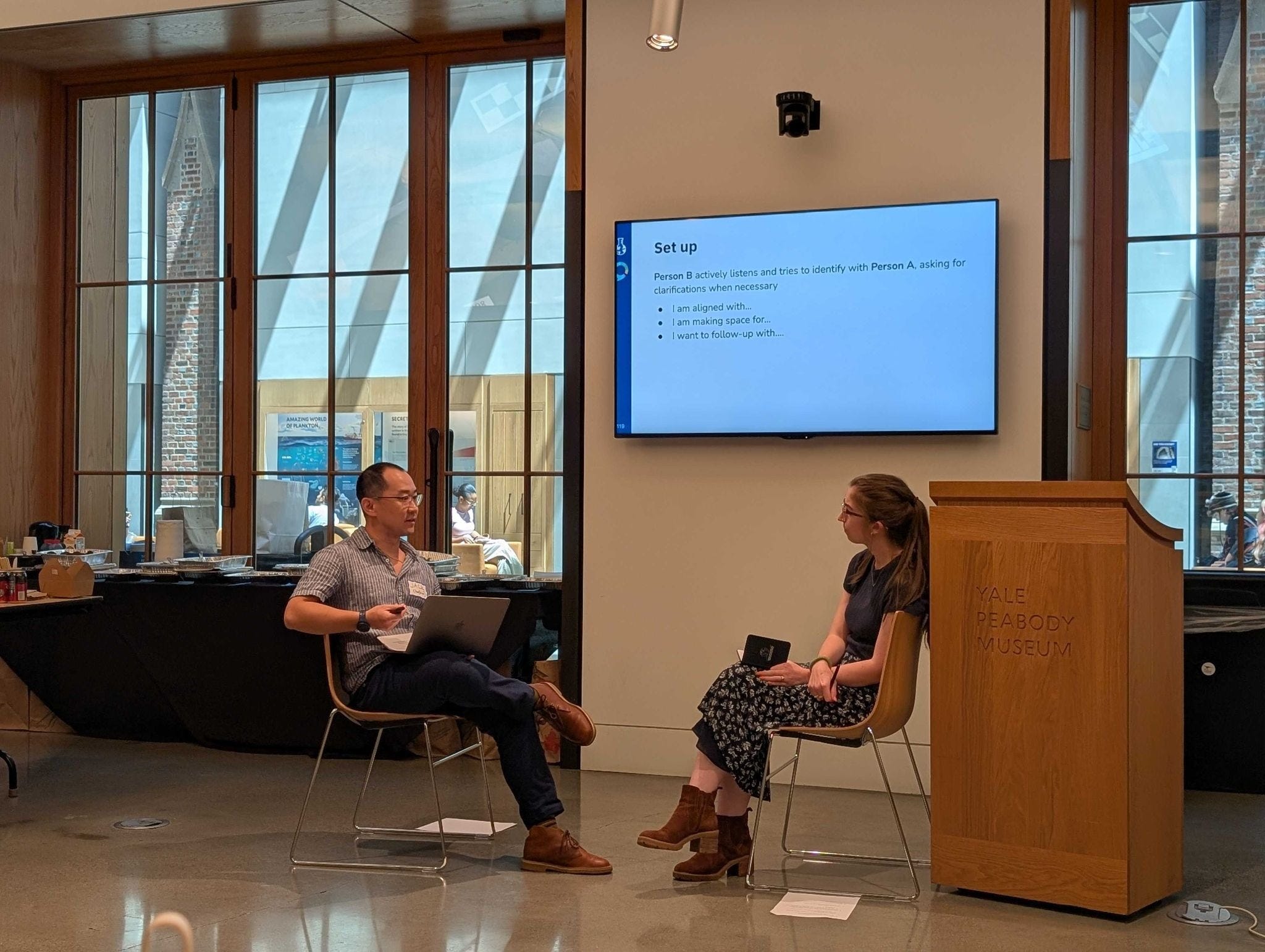
This multiday gathering brought together social scientists and climate movement practitioners to share knowledge and strategies, build collaborative relationships, and discuss shifting dynamics in the climate communication and policy landscapes. To this end, Grace presented research from Data for Progress survey partnerships completed over the last year, including projects on the relationship between the climate and cost-of-living crises, data center attitudes, and policy preferences for climate and environmental action.

Platner’s Energy Plan Is Popular Nationwide
Our new polling finds Graham Platner’s new energy plan, “Take Back American Power: End Big Oil Price Gouging, Build Now” is widely popular nationwide. Platner, the Democratic nominee for U.S. Senate in Maine, has proposed levying a 50% tax on oil and gas companies’ when they make windfall profits, then using any collected revenue to freeze or lower electricity rates for Americans. A strong bipartisan majority of voters (69%) support this proposal. Voters also broadly support other key planks of Platner’s plan, including:
Developing a strategic national stockpile of clean energy technologies to lower the cost of domestically manufactured components and products (69%);
Creating a National Energy Infrastructure Fund to fund new clean energy projects (68%); and
Reforming the permitting process to review and approve clean energy projects more quickly (67%).
Voters Support a Data Center Moratorium
As Beltway X users debate the merits of a data center moratorium, we find that a majority of voters (63%), including 67% of Democrats, 66% of Independents, and 58% of Republicans, support pausing the construction of AI data centers for at least one year. Respondents were also asked whether they think the development of AI in the U.S. should be sped up, be slowed down, or remain the same. A plurality of voters (43%) think development should be slowed down, while 37% want the pace to remain the same and 13% want it sped up. Read the full brief here.

Climate Action Is a Popular Solution to the Affordability Crisis
By Grace Adcox
For months, groups across the political spectrum have assailed the left’s work on climate. On one side, we hear the right-wing refrain calling climate policy a “Green New Scam” that drives up costs — without acknowledging the higher costs families are already being asked to pay for home insurance, disaster recovery, and more. On the other side, there’s a growing narrative that claims climate is a niche or losing issue that alienates the working class, and that we should stop talking about it and focus solely on “affordability” instead.
Both approaches are out of step with the American voter. Recent polling from Data for Progress and the Climate and Community Institute reveals that voters don’t buy the claim that we shouldn’t — or can’t — tackle affordability and climate at the same time. In reality, voters not only care about climate, they also believe that climate and cost-of-living issues can and should be addressed together by policymakers.
Fifty-five percent of voters want to see elected officials take an approach that addresses both climate and affordability simultaneously, compared with only 35% who want to focus on costs alone. Core climate constituencies — including 73% of Democrats and 62% of voters under 45 — support this approach, but support extends beyond these traditional constituencies as well. A majority of Independents (56%) and even around 2 in 5 Republicans (38%) want to address the climate crisis along with the cost-of-living crisis.
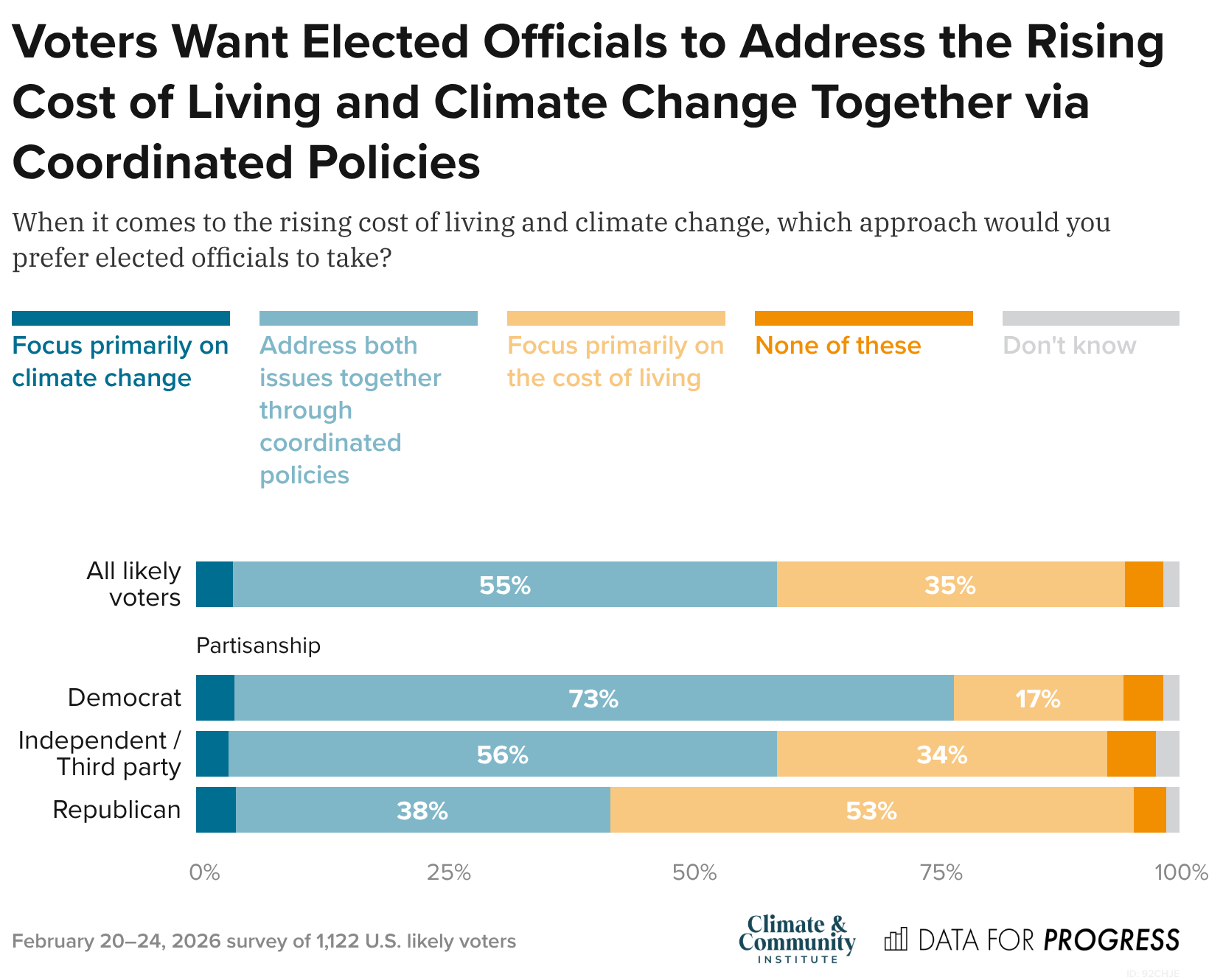
Amid a multiyear cost-of-living crisis, voters are connecting the dots between climate and affordability. Voters are already feeling the financial impacts of the climate crisis — not the abstract future consequences of glacial melt or biodiversity loss, but rather the tangible kitchen-table impacts that keep families up at night, including:
Rising home insurance costs and insurance companies exiting the market: 89% of voters want policymakers to take action on insurance affordability as extreme weather drives premiums to record highs.
Compounding extreme weather risks: 91% of voters want policymakers to protect their homes and communities from the increasing frequency and costs of extreme weather disasters.
Skyrocketing utility costs: 79% of voters want policymakers to invest in renewable energy sources, which the electorate already knows are cheaper than fossil alternatives.
Green Economic Populism can meet this moment of intersecting crises and deliver for the working class. The Climate and Community Institute’s Stop Greed, Build Green GEP agenda is designed to implement durable climate and economic solutions by building a winning and lasting political coalition.
Americans are tired of waiting for some miracle invisible hand of the market to lower household costs — they want their government to act. Fifty-six percent of voters want to see the government take a more active role in addressing climate change and the cost of living through public investment and stronger regulations. Just 26% believe that we should rely on the private sector to fix these problems.
By expanding the reach and capacity of the public sector, Green Economic Populism can deliver tangible relief to working families, curb corporate greed, and strengthen confidence in public institutions.
As November’s midterms approach, the stakes for climate, democracy, and the economy are clear. Candidates do not need to run away from climate to win over working-class voters. Instead, they can embrace a green economic populist framing, which 72% of voters say is a convincing reason to support a candidate.
It’s harmful and counterproductive to continue treating the climate and the economy as competing or conflicting issues, and voters don’t buy this false choice. We can deliver for the working class by leaning into an agenda that champions a future where everyone can afford to live.
You can find Grace’s Insights piece on our website here.

“Trumpian State Capitalism,” by Ilias Alami and Thea Riofrancos (Phenomenal World)
“Why Renters Have to Fight for Their Right to Air Conditioning,” by Jeva Lange (Heatmap News)


 |
|