
Nothing Spookier Than Climate Overshoot
Welcome back to Data for Climate Progress — your one-stop shop for all things climate at Data for Progress.


Welcome back to Data for Climate Progress — your one-stop shop for all things climate at Data for Progress. Catch us here every month for our latest climate polling, juicy insights, and can’t-miss reading lists.
As always, we’d love to hear from you — drop us (Grace Adcox and Catherine Fraser) a line at gracea@dataforprogress.org and catherine@dataforprogress.org. Forwarded this email? You can subscribe below.
Love this newsletter? Want to support our work? Donate here:

Meet DFP’s New Executive Director, Ryan O’Donnell
It’s official: Our next executive director is Ryan O’Donnell. Ryan has been with DFP since the very early days. He brings over two decades of experience in the progressive field — notably through his tenure with SEIU and Obama’s 2008 presidential run, and advising numerous partners over the years, including AOC’s first bid for Congress and the Working Families Party.
At DFP, Ryan has played a pivotal role in strengthening our methodological rigor, ensuring our accuracy, and leading innovative polling on topics other firms are often unwilling to touch.

In the three years we’ve worked together, Ryan has been a constant supporter of DFP’s climate team. We’re thrilled to continue our work under his leadership to advance a green, economic populist agenda for climate.
In a time of spiraling climate and political chaos, and calls in some quarters for moderation, ceding ground, or shying away from era-defining issues like climate change, LGBTQ+ rights, and the genocide in Gaza, we’re proud to announce a new executive director who is committed to building a progressive movement rooted in data, integrity, and ambition.
But don’t just take our word for it … hear it from Ryan himself.

And go follow Ryan on Twitter and Bluesky.

More Public Transit for the Twin Cities
Earlier this month, our poll with Move Minnesota was featured in the Minnesota StarTribune, finding that 1 in 3 Twin Cities residents are curious about being car-free. What’s more, we find that 83% of Twin Cities adults agree that robust public transit options are good for everyone, and that more than 60% of residents already consider public transit for certain trips. Even if Twin Cities adults don’t use public transit, 55% know someone who personally benefits from using it. Among Black and under 45 respondents, this number jumps to 74% and 64%, respectively, underscoring the importance of public transport among residents of color and younger residents, and of ensuring that the Twin Cities offer equity in mobility for everyone. Read the full report from Move Minnesota and Data for Progress here.

Amid Overshoot, Climate Clarity at Carnegie Endowment for International Peace
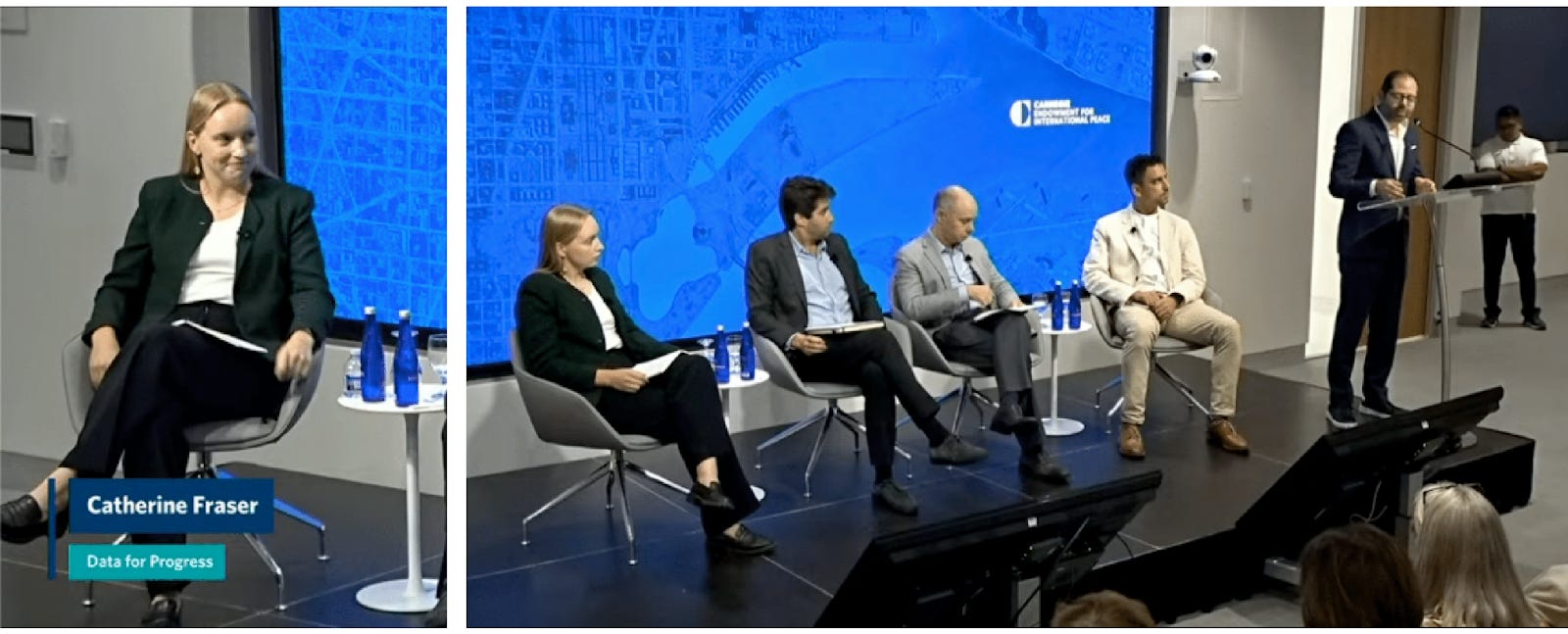
Earlier this month, DFP’s Catherine Fraser joined a panel discussing a new Carnegie Endowment piece by Leonardo Martinez-Diaz, Noah Gordon, and Milo McBride, titled Climate Clarity: On the Future of Climate Action in the United States. The piece identifies a dangerous rising tide of “new denialism” in U.S. climate politics. New denialism, in the authors’ words, is “rooted in the idea that decarbonization is unrealistic and expensive, and that the U.S. can safely double down on fossil fuels while adapting to climate hazards.” In a rebuke of this new denialism, Catherine shared what our latest polling indicates about voter attitudes toward climate change and discussed her recent piece in Common Dreams critiquing the Council on Foreign Relations’ turn to new denialism via its “Climate Realism Initiative.”
With the United Nations’ António Guterres sounding the alarm this week that humanity will overshoot the Paris Agreement’s 1.5 C climate target, resulting in “devastating consequences” for people and the planet, let us be unequivocal: We must immediately move to cut emissions and phase out fossil fuels.
At DFP, we urge the climate movement to not heed the calls to give up, tackle emissions cuts down the road, or lump all of our eggs into a basket of supposed climate fixes — like carbon removal or geoengineering — that treat symptoms, not root causes, of climate change.
Climate change is an existential threat. There is no time for delay, denial, or giving up — we owe future generations and those most vulnerable to climate change an unwavering commitment to emissions cuts and the end of fossil fuels.
Talking Barriers to Local Renewable Energy Siting
DFP’s Grace Adcox presented findings from our recent report with Clean Tomorrow about state policymaker perspectives on renewable energy siting to the Siting Clean Collaborative. We surveyed and interviewed state-level siting policy stakeholders across 17 states, including elected legislators and agency staff.
Stakeholders reported facing significant obstacles in the siting process related to community opposition and misinformation, as well as “direct or institutional barriers,” such as restrictive local ordinances and difficulty securing transmission grid connections.
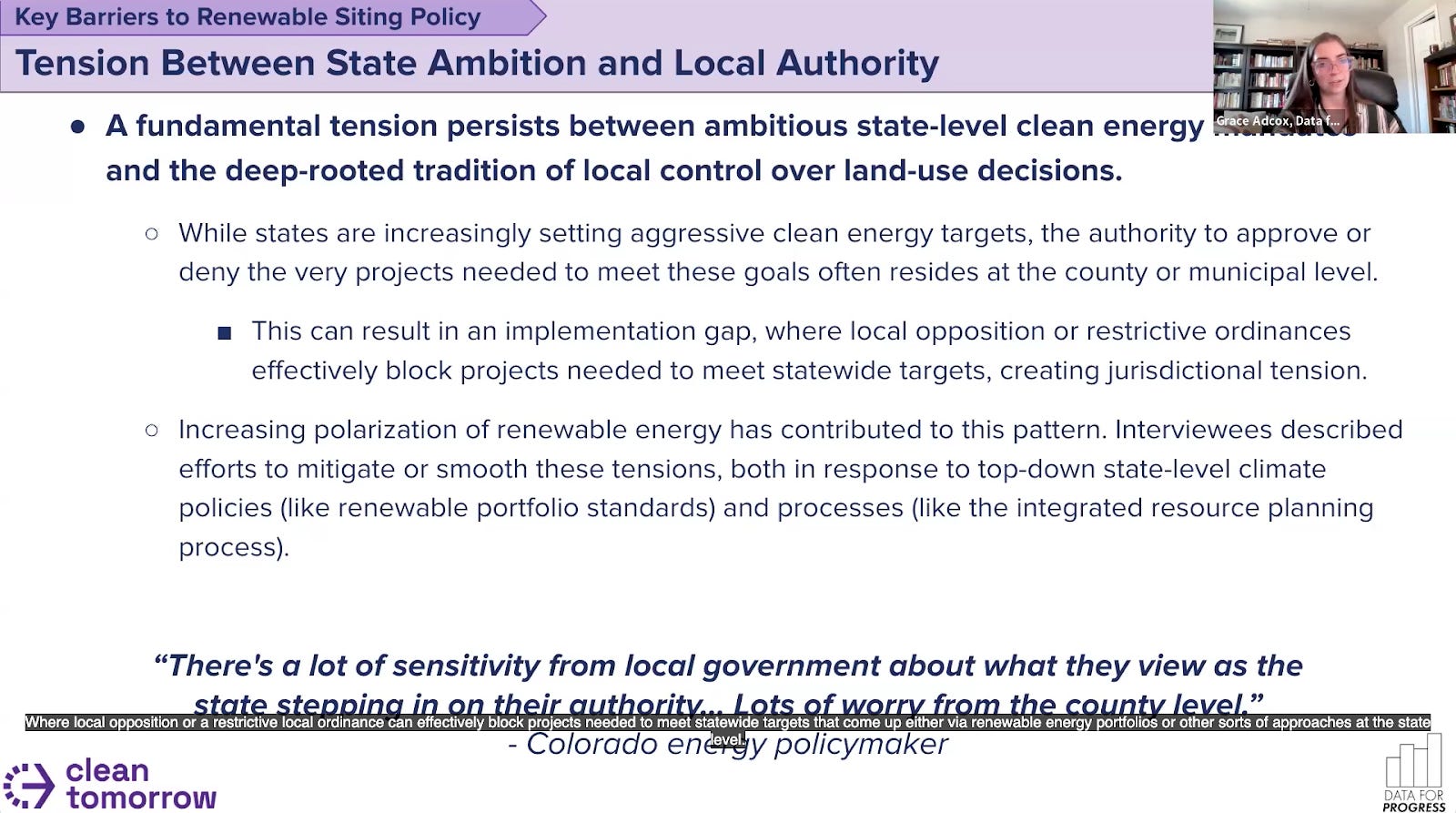
To address these barriers, policymakers identified a series of policies and tools to improve siting, including mandating or incentivizing siting standards for local government adoption, prohibiting overly restrictive ordinances, and developing playbooks of best practices and case studies of successful policies. You can read the full report here.

Democrats Have the High Ground on Energy Prices — if They’re Willing to Take It
By Grace Adcox and Abby Springs
In a speech made at the United Nations General Assembly last month, President Donald Trump described climate change as the “greatest con job ever perpetrated on the world” while slamming efforts by European nations to develop clean energy.
But here at home, energy prices have risen at more than double the rate of inflation. In Data for Progress polling, 62% of voters report paying more for their utility bills now than last year, including majorities of Democrats, Independents, and Republicans.
The cost of living was a key driver of Trump’s victory last November, and remains the top issue for voters nearly a year later. But not only has Trump failed to lower prices, his war on clean energy has pushed the cost of energy bills up even further.
To demonstrate to voters that they’re the party with a plan to make life more affordable, Democrats will have to prove that they are actually tackling the cost of living ahead of the 2026 midterms. Democrats need an agenda to combat high energy prices — one that leverages their popular positions on clean energy, centers economic populism, and calls out the bad actors driving up utility costs.
Democrats Can Leverage Their Advantage on Climate and Energy
Currently, neither party has a significant trust advantage on “electric utility bills” (D+1) or “the cost of living” (R+1). However, Democrats hold a +14-point trust advantage on “climate change” and a +6-point advantage on “renewable energy development.”
That trust advantage gives Democrats solid ground from which to launch an attack. Due to the strong popularity of wind and solar energy, as well as voter perceptions that these are the cheapest sources of energy, Republicans will have a tough time shifting blame for high energy prices onto Democratic policies that incentivize renewables.
Wind and solar energy, along with natural gas, consistently rank as some of the most popular forms of energy. That’s despite years of Trump attempting to portray wind and solar as harmful to the economy, wildlife, and public health.
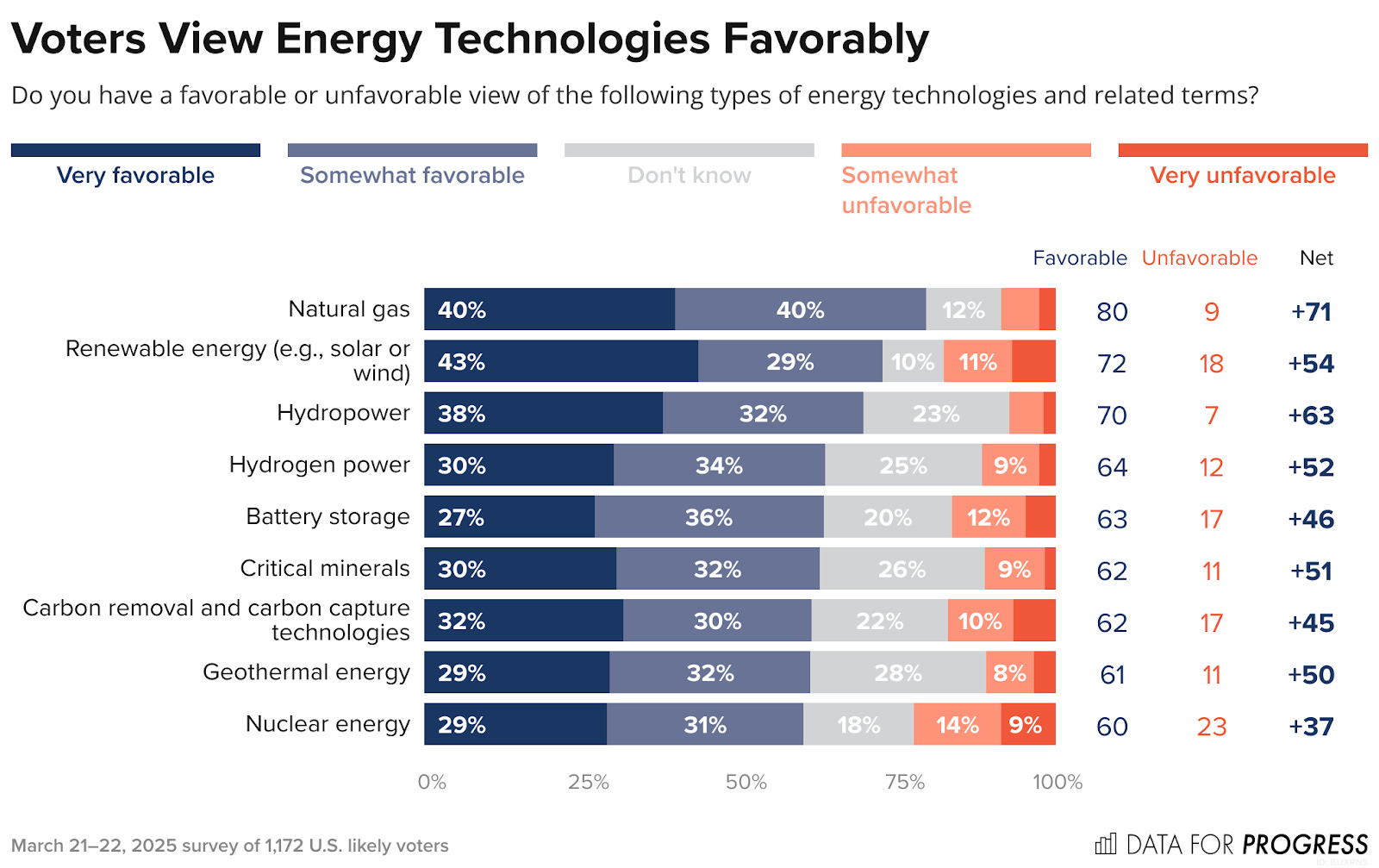
Our polling has also found that voters already correctly identify wind and solar as the cheapest forms of energy and more affordable than other energy technologies.
And when we asked voters who or what they blame for higher electricity prices, wind and solar energy ranks dead last, with only 5% of voters selecting increased reliance on these technologies. Instead, voters most often blame utility companies for increasing profits and increased energy demand from new industries like AI.
High Energy Prices Open an Economic Populist Lane
In the press, on social media, and in town halls, Democrats need to drive home their plan to actually lower electric bills.
That means calling out the bad actors that are driving these rate hikes — including Trump and his war on clean energy; utility monopolies charging junk fees, ripping off ratepayers, and lobbying against clean energy; and Big Tech companies that are forcing the public to foot the bill as they build data centers that are straining the power grid.
Beyond just calling out bad actors, Democrats must offer an alternative vision for lowering costs. Renewables offer the cheapest and most reliable path to strengthen our grid and reduce household energy burdens. But, to make a cleaner, more resilient grid a reality, Democrats need to pair investments in renewables with smart policies targeted to keep utilities and fossil fuel companies from passing inflated costs on to ratepayers. That also means embracing a bold energy agenda that cracks down on price gouging, modernizes the grid and builds energy resilience, requires large-load consumers like data centers to foot their own bills, and supports publicly owned clean energy projects that yield direct benefits for communities.
Voters must see a clear choice: to elect a Democrat who will fight to cut their bills and keep their lights on, or to elect a Republican who will protect their corporate donors’ interests. If Democrats can show they are serious about tackling the electricity affordability crisis with clean, cheap power and credible protections for working families, they won’t just win on climate, but also on the cost of living.
Read the full Insights piece here.

NEW from DFP fellow Betony Jones: “Tying Labor Standards to Clean Energy Incentives: How Biden’s Department of Energy Tackled Climate Industrial Policy,” by Betony Jones (Roosevelt Institute)
“The Long Heat: Climate Politics When It’s Too Late,” by Andreas Malm and Wim Carton (Verso)
“California’s Big Climate and Energy Package, Explained,” by Emily Pontecorvo (Heatmap)
“All Guns and No Butter on a Burning Planet,” by Khem Rogaly and Patrick Bigger (Jacobin)
“How Trump gutted the team meant to build America’s energy future,” by Maria Gallucci (Canary Media)


 | A guest post by
|