Data Center? I Barely Know Her
Welcome back to Data for Climate Progress — your one-stop shop for all things climate at Data for Progress.



Welcome back to Data for Climate Progress — your one-stop shop for all things climate at Data for Progress. Catch us here every month for our latest climate polling, juicy insights, and can’t-miss reading lists.
As always, we’d love to hear from you — drop us (Grace Adcox and Catherine Fraser) a line at gracea@dataforprogress.org and catherine@dataforprogress.org. Forwarded this email? You can subscribe below.
Love this newsletter? Want to support our work? Donate here:

Focus Groups on California’s Battery Boom
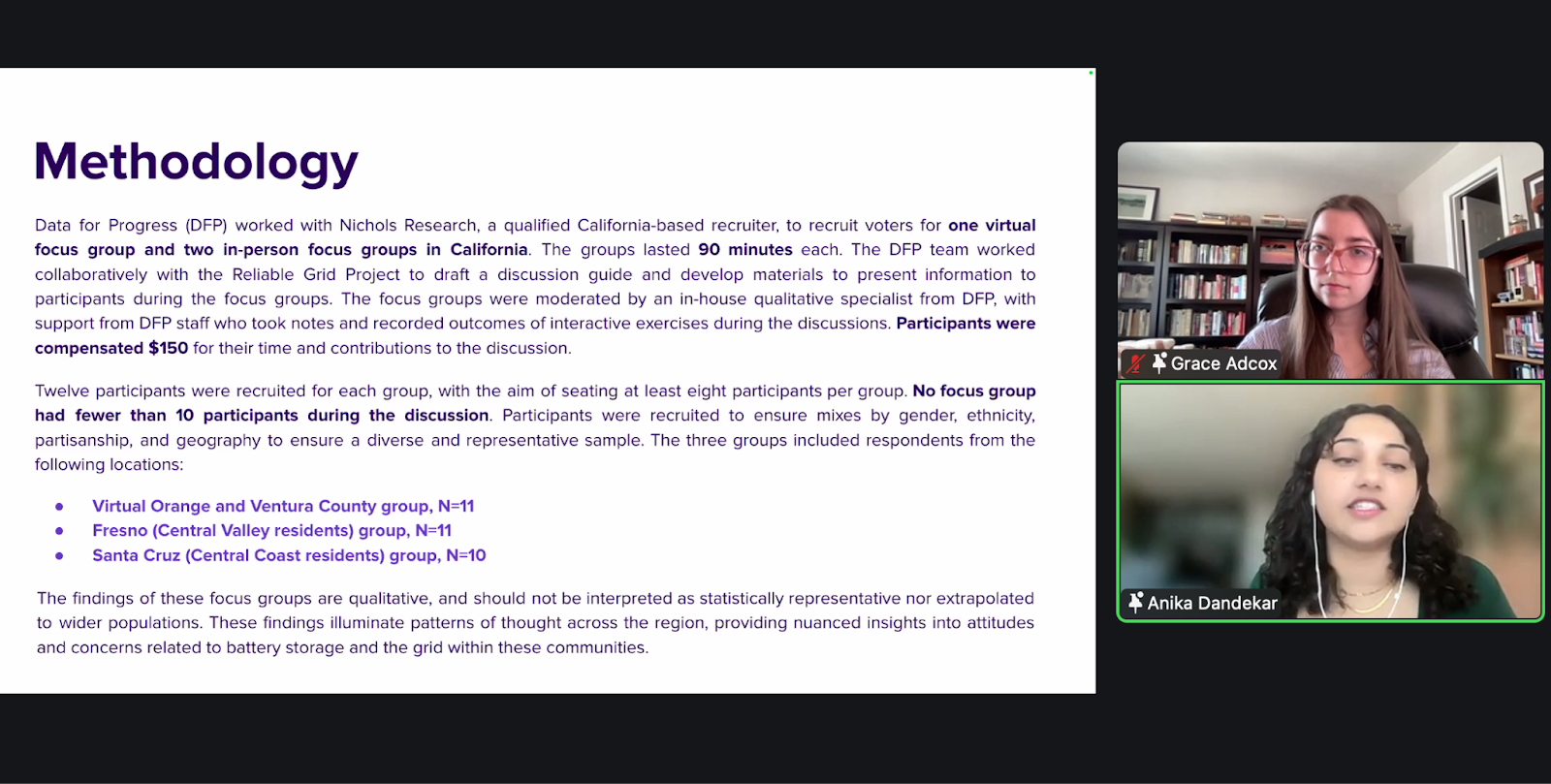
DFP’s Anika Dandekar and Grace Adcox joined the Reliable Grid Project for a webinar to present our findings on a series of focus groups in California. We hosted three focus groups in California — in Orange and Ventura counties, the Central Valley, and the Central Coast — to understand attitudes on the state’s growing battery storage industry, especially in the wake of the 2025 Moss Landing fire. We find that most Californians know little about existing battery storage projects, and our subsequent report identifies opportunities to leverage trusted actors and local familiarity with existing, household-level renewable energy technologies to inform Californians of the benefits, costs, and risks of utility-scale battery storage projects. You can read the full report here.

One More Reason To Be Anti-War: Its Climate Impacts
Already widely unpopular among U.S. voters, the war on Iran becomes even more unfavorable in the eyes of voters when they learn of its climate impacts. According to research from the Climate and Community Institute, the first two weeks of the war produced 5 million metric tons of carbon emissions — more than Iceland produces in an entire year. Much of these emissions came from destroyed buildings, burning fuel facilities, and military attacks. After learning about these climate impacts, 63% of Democrats – 88% of whom already view the war unfavorably – say they have a worse opinion of the Trump administration’s decision to take military action against Iran.
New Yorkers to Big Oil: Pay Up
Our new polling with the Center for Climate Integrity finds that voters across New York state are experiencing rising housing and home insurance costs firsthand, with more than half (54%) saying that their home or renters insurance bill has increased in the last year, including 68% of homeowners. Beyond just rising home insurance rates, nearly two-thirds of New Yorkers (64%) — and 79% of Democrats — report that instances of extreme weather have become more frequent over the last five years. Who’s to blame? New Yorkers say Big Oil. Nearly 7 in 10 New York voters (69%) say large oil and gas companies are very or somewhat responsible for climate change and worsening extreme weather disasters. This includes 85% of Democrats, 64% of Independents, and even a slim majority of Republicans (52%). New York voters are ready to make polluters pay. Two-thirds support legislation that would allow the state attorney general to sue the oil and gas industry to recover home insurance cost increases — rather than letting insurers pass those costs onto New Yorkers. Read the full brief here.

Still Talking About Data Centers
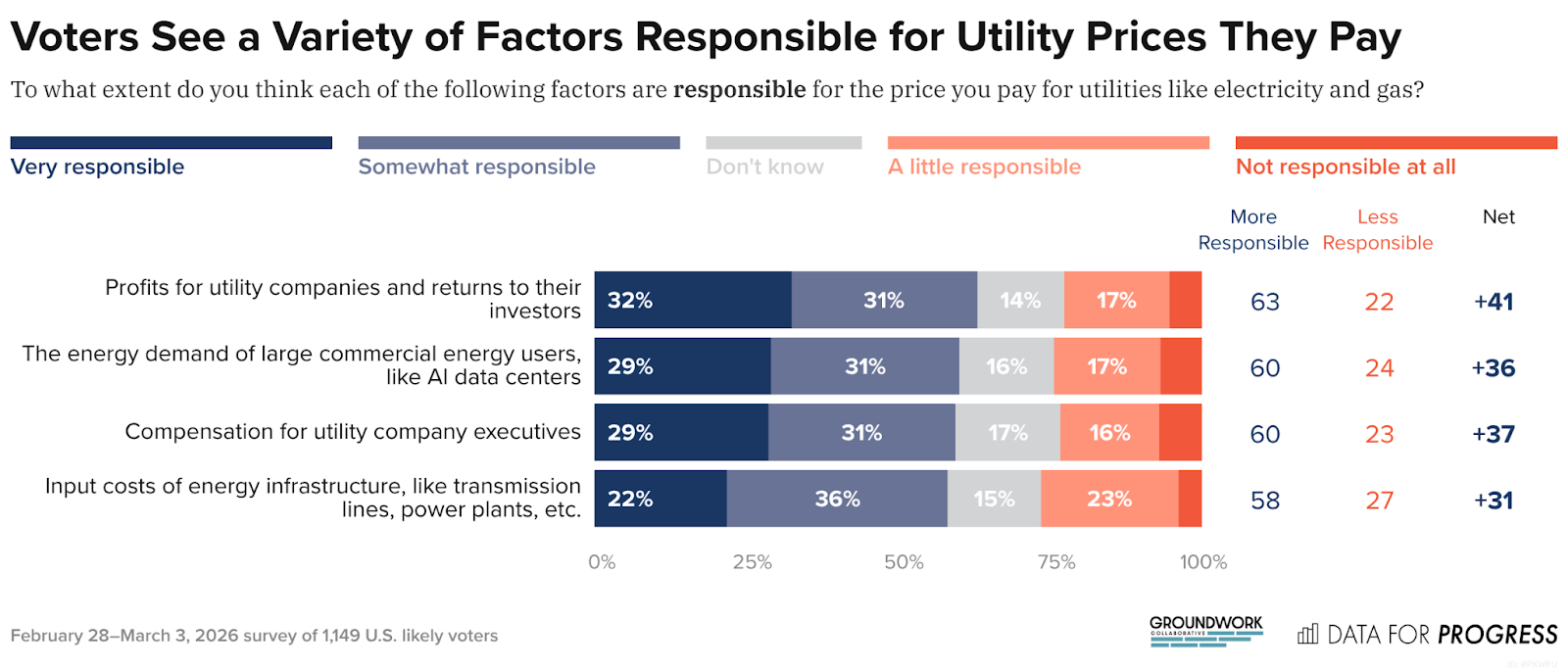
This month, we released a new poll with Groundwork Collaborative which explores attitudes toward electricity prices, utility companies, and data centers. We find that two-thirds of voters (66%) say their monthly electricity bill has gone up in the last year, with majorities blaming utility company profits, the energy demand of large energy users (like data centers) and compensation for utility company executives.
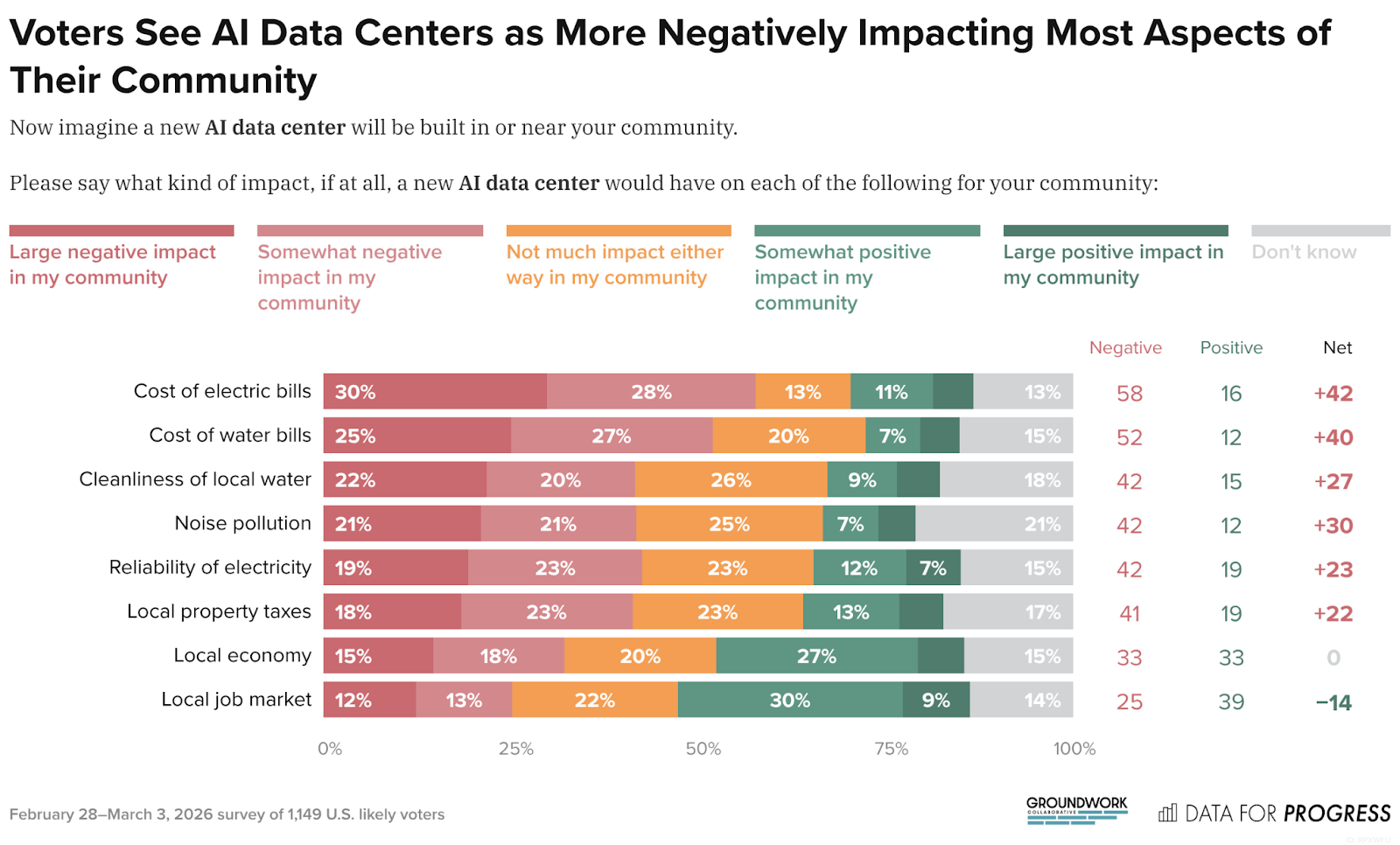
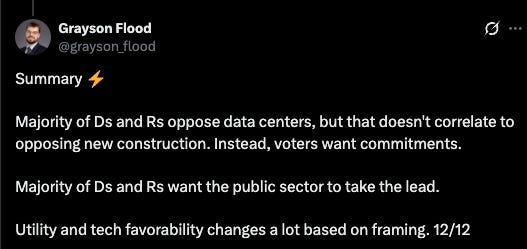
Though a slim majority of voters (51%) say that they’ve seen, read, or heard “nothing at all” about AI data centers being built in their community, a bipartisan majority (57%) would oppose a data center if it was proposed in their community. When asked about their perceptions of potential impacts of AI data centers on their community, voters see AI data centers as having mostly negative impacts on their community, particularly in terms of cost of electric and water bills, cleanliness of local water, noise pollution, and the reliability of electricity.
That said, voters are divided on whether data centers will bring jobs, but largely think that AI data centers will raise their utility bills by increasing demand and thus making electricity more expensive. To reduce the impact of new data centers on utility bills, voters think requiring AI data centers to build their own dedicated power plant would be most effective.
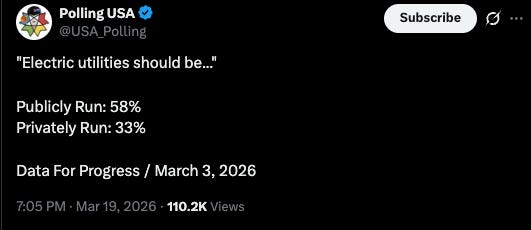
Finally, we asked whether electric utilities should be publicly or privately run, and a majority of voters (58%) — a +25 margin — say that the public sector should run them. This includes majorities of Democrats (65%) and Independents (61%).
Our friends at Groundwork said it best: To lower prices, voters want the public sector to play a larger role in modernizing and running utilities and for federal policymakers to rein in corporate actors like AI companies that make electricity and gas more expensive.
Read Groundwork’s write up here and the crosstabs here.

“The Energy Supply Shock of the Iran War Changes Everything,” by Matthew Zeitlin (Heatmap)
“The fate of fossil fuel systems in the “mid-transition”,” by David Roberts (Volts)

Check Out DFP’s Ryan O’Donnell on The New Republic’s Podcast: