
Climate Change Is Running AMOK With AMOC
Welcome back to Data for Climate Progress — your one-stop shop for all things climate at Data for Progress.



Welcome back to Data for Climate Progress — your one-stop shop for all things climate at Data for Progress. Catch us here every month for our latest climate polling, juicy insights, and can’t-miss reading lists.
As always, we’d love to hear from you — drop us (Grace Adcox and Catherine Fraser) a line at gracea@dataforprogress.org and catherine@dataforprogress.org. Forwarded this email? You can subscribe below.
Love this newsletter? Want to support our work? Donate here:

Green Economic Populism: A Working-Class Climate Agenda
A new report from the Climate and Community Institute and survey from Data for Progress demonstrate that voters are increasingly connecting the dots between extreme weather and their straining bank accounts, and want policymakers to do something about it. Fortunately, this data also shows voters see a path to deliver solutions that simultaneously respond to both the climate and cost-of-living crises: 70% of voters believe that effective climate policies can also lower the cost of living, and 55% want policymakers to pursue policy agendas that tackle both issues in one fell swoop. In its agenda and white paper, CCI describes this dual-pronged policymaking framework as Green Economic Populism. By pairing kitchen table interventions like free transit and home insurance rate caps with a laser focus on corporate accountability and a fortified public sector, Green Economic Populism aims to deliver ambitious climate progress while driving down costs for working-class people. See Grist’s coverage of the agenda and polling here.
No Clean Energy Cold War With China
With China outpacing the rest of the world in the development of clean energy and climate technologies, new polling from DFP examines U.S. likely voter attitudes toward China in the context of climate change, clean energy technologies, and the energy transition. We find that a plurality of voters (47%), including majorities of Democrats (58%), Independents (52%), and voters under 45 (55%), agree more with a statement saying, “We’ll make progress on clean energy technologies faster if the United States prioritizes cooperating with China on the development and manufacturing of these technologies,” while 39% say we’ll make faster progress if we prioritize competition. What’s more, despite China’s global leadership in climate technologies, when asked whether they think the U.S. or China is the global leader in developing clean energy technologies, a slim majority of Americans (52%) choose the U.S. Read the polling brief here.
Biden-Era Clean Energy Awards Escape Purgatory
This month, Energy Secretary Chris Wright sent a list of 1,950 Biden-era clean energy awards that have been “retained” or “modified” by the Trump administration, giving the green light to projects like the Project Cypress direct air capture hub and 13 previously canceled Grid Resilience and Innovation Program projects. As long on-hold projects finally got the go-ahead this month, DFP released a new tool to better identify known community and labor agreements on major Department of Energy awards. The Labor and Community Benefits Agreements Map shows known agreements on Biden-era DOE investments exceeding $50M. The tool complements DFP fellow Betony Jones’ new paper for the Roosevelt Institute, The Receipts: The Untold and Underappreciated Outcomes of Biden’s Clean Energy Strategy. Betony and her co-author, Joe Peck, highlight four key takeaways from an analysis of Joe Biden’s energy strategy:
Biden-era clean energy investments “crowded in” private capital;
Wage requirements ensured jobs in these communities paid well;
Incentive-based apprenticeship rules helped build the workforce needed to make this strategy real; and
Labor and community standards resulted in better jobs and stronger projects garnering less opposition.

AMOC Should’ve Been Front Page News This Earth Month
By Catherine Fraser
A whopping 20 million Americans — 10% of the U.S. population at the time — participated in the first Earth Day on April 22, 1970. New polling from Data for Progress finds that more than 60% of U.S. voters say Earth Day is important to them personally, including majorities of Democrats (73%), Independents (60%), and Republicans (53%).
Support for protecting the Earth’s air and water is also high across party lines, with a strong majority of voters (66%) agreeing that ensuring every community has access to clean air and water should be a top priority for the U.S.
Despite broad public support for protecting clean air and water, the Trump administration has touted its rollbacks of environmental rules as the “biggest deregulatory action” in U.S. history, and has sought to reverse much of the climate action taken by the Biden administration — slashing funding and programs that incentivized clean energy, ending the government’s ability to regulate greenhouse gas emissions in certain sectors, and pushing fossil fuel production over renewable energy.
These actions couldn’t come at a worse time. With the world on the verge of overshooting the Paris Agreement’s target of limiting warming to 1.5 degrees Celsius, each incremental rise in temperature further accelerates our race toward cascading and irreversible climate tipping points. New research this month shows that, given current levels of warming, one such tipping point — the collapse of the Atlantic meridional overturning circulation, or AMOC — is more likely than previously thought.
Forget “The Shining” or the villain from that one scary movie — the collapse of AMOC is what should keep you up at night. AMOC is a critical ocean current that sends warm water from the Southern Ocean near Antarctica northward through the Atlantic Ocean, cooling as it reaches the Arctic, where the current then begins to return the water to the Southern Hemisphere. The current is responsible for rainfall in the tropics and brings warm water to Northern Europe, enabling notoriously rainy weather in the UK and Ireland, as well as the region’s mild winters.
Needless to say, its collapse could bring catastrophic consequences. Winters could see temperatures as low as -4°F in the UK and -54°F in Oslo, Norway, where winter temperatures currently average 39°F and 32°F, respectively. Meanwhile, the typically rainy tropics could dry up, disrupting growing seasons and livelihoods. Here in the U.S., the East Coast could see rapid sea level rise and stronger hurricanes.
I’m not trying to be a climate doomer. Rather, I want to be clear-eyed about the consequences of inaction or delay — and hope you do, too.
It’s only by facing the hard truths and the terrifying potential of climate overshoot that we can act with ambition and conviction to limit catastrophic warming.
And, this Earth Month, we know that’s what voters want, too. Sixty-eight percent of voters — majorities of Democrats, Independents, and, yes, Republicans — want the U.S. to take ambitious action on climate change, even if other countries don’t.
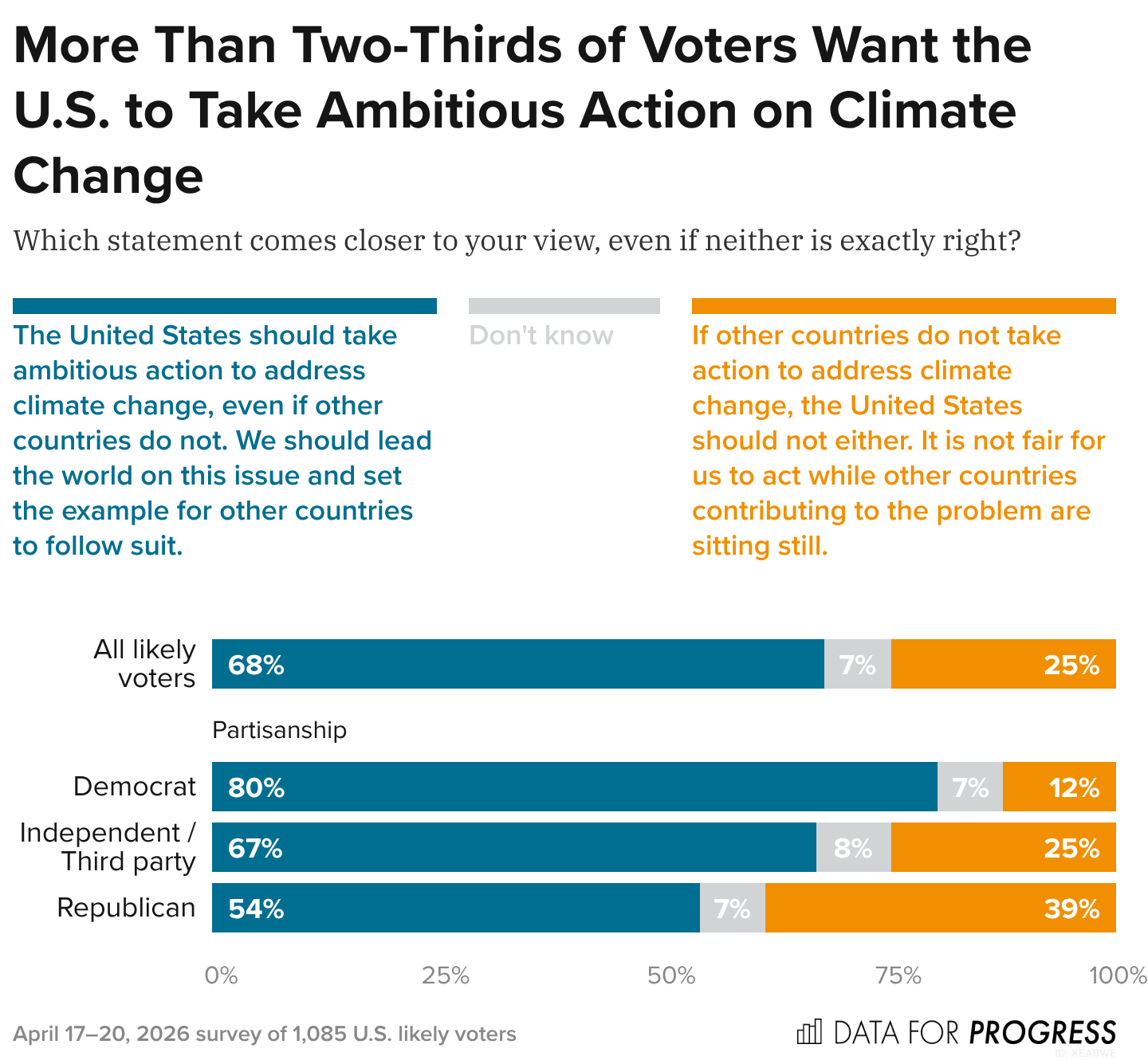
Read the full polling brief here.

Our friends at the UAW Center for Manufacturing a Green Economy (CMGE) are on Substack, check out The Just Transmission here
“Democrats May Believe Climate Change Is Real. They Don’t Act Like It.” by Kate Aronoff (The New Republic)
“The Case For Public Factories,” by Ganesh Sitaraman and Joel Dodge (Vanderbilt Policy Accelerator)
“Trump Brings Back Direct Air Capture Hubs,” by Emily Pontecorvo (Heatmap)
“The Green New Deal has evolved. Now it’s all about ‘affordability.’” by Kate Yoder (Grist)

