
Voters Are Ready to Transform Housing With Green Industrial Policy
Data for Progress and Climate and Community Institute's monthly snapshot of the widespread demand and pathways forward for climate action.



Intensifying political chaos and insufficient planning to combat climate and economic crises pose existential challenges. In this newsletter, we offer a monthly snapshot of the widespread demand for climate action and pathways forward.

Voters Are Ready to Transform Housing With Green Industrial Policy
The United States faces twin crises: a deepening housing shortage and an accelerating climate emergency. Millions of Americans struggle to make rent or buy a home, while seeing their utility prices and utility debt soar to historic highs, driven by rapidly growing energy demand, poorly insulated homes, and increasingly extreme weather. Yet housing remains largely absent from federal climate strategies, and climate remains an afterthought in many affordable housing debates. To address these crises, we must shift from piecemeal policy efforts to a coordinated, federally backed transformation of the housing sector.
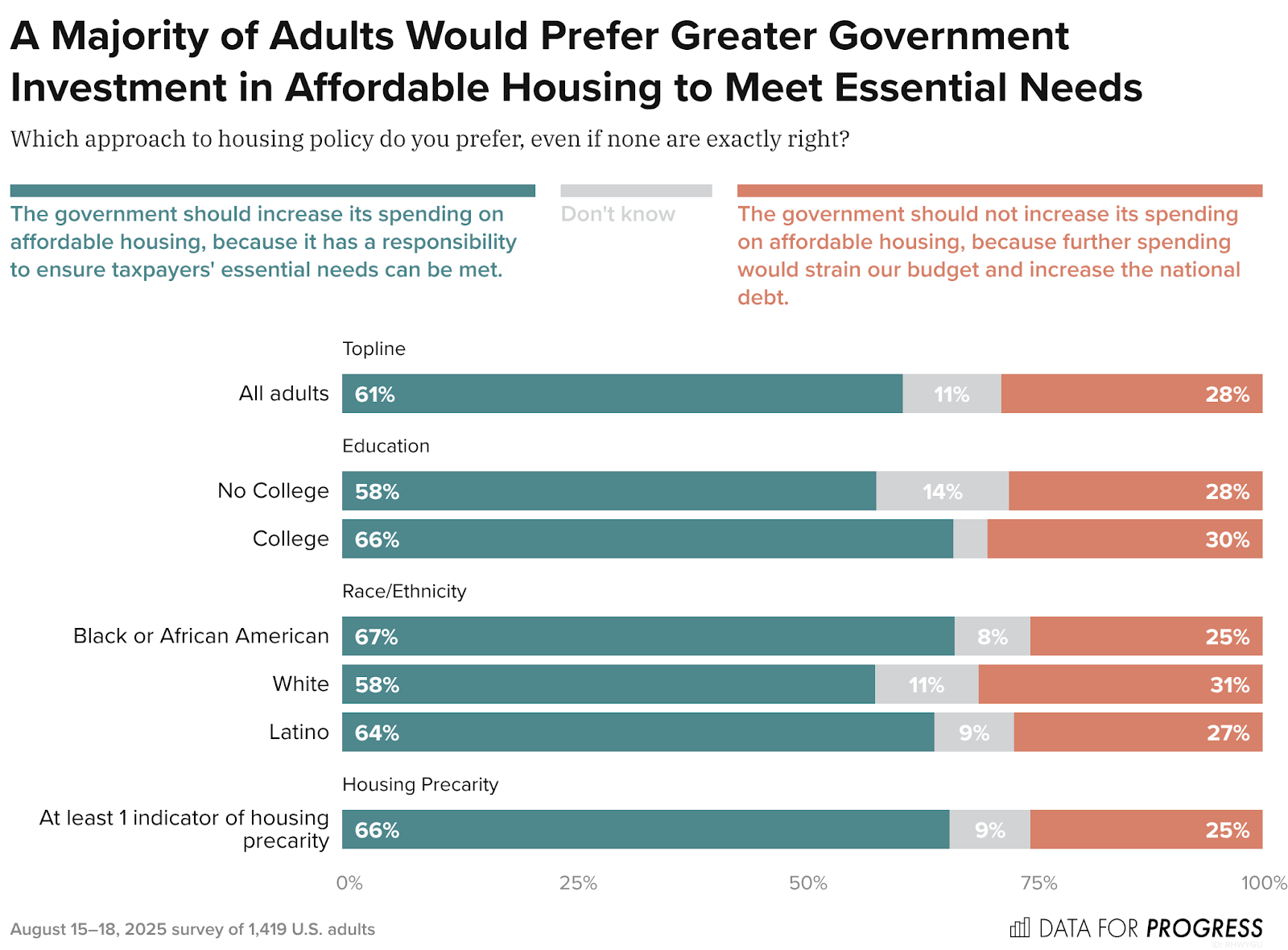
And new polling from Data for Progress finds the public is ready for this shift. More than 3 in 5 U.S. adults (61%) support increased federal spending on affordable housing, a +33-point net margin of support. Voters increasingly recognize housing not just as a market commodity, but as an essential public good — one that the federal government has both a responsibility and a mandate to deliver.
Climate and Community Institute’s recent report, Transforming the Housing Sector with Green Industrial Policy, shows how we can entirely reshape the housing sector to deliver on demonstrated popular demand for affordable housing. To decarbonize, decommodify, and democratize the housing sector, we must double housing construction, rapidly expand the retrofitting of existing homes, and do so with union labor, clean energy, and domestically manufactured materials. With a nationally coordinated strategic approach, we can align the supply chain, workforce, and funding streams needed to effectively deliver affordable and sustainable housing at scale.
Housing and climate strategy go hand in hand. As CCI makes clear, investing in green social housing delivers cascading benefits beyond just greater housing affordability, including lower energy bills, reduced emissions, climate-resilient communities, and millions of good-paying jobs. Furthermore, adopting green housing industrial policy means we can lower the costs of green housing materials; build coalitions across government, industry, labor, and residents; and layer complementary policies to help those in greatest need reap the benefits of upgraded homes. In short, public support for housing is part and parcel of ensuring security, dignity, and stability in an increasingly volatile world.
The blueprint exists and voters are ready. What’s needed now is the political will to champion green, affordable housing as core infrastructure and as a central pillar of climate and economic justice.

 | A guest post by
|